Most centres dilute IB students into A Level classes. ETG does the opposite. IB students sit in dedicated IB classes, taught from an in-house IB curriculum and IB specific textbooks, by a team trained to teach the IB rubric, not just the content. It is a quieter, more deliberate kind of programme, built for families who expect excellence.
In recent cohorts, over 95% of our IB students scored a 7, self-reported by students. Self reported figures carry the usual response and selection bias, and past results do not guarantee future ones. We show the figure because students told us themselves, but the student voices below are the better proof.
IB Economics is not A Level Economics with different paperwork. It accepts two aggregate supply models where A Level runs on one. It pays for real world examples in a way A Level does not. It has a Paper 3 and an Internal Assessment that A Level has no equivalent of. The gaps are small, specific and expensive, and a tutor trained on A Level has no particular reason to know where they are. Here are six of them, written down.
The IB accepts the monetarist model, with a vertical LRAS at potential output, and the IB Keynesian AS. Most IB teachers run on the monetarist one. A Level runs on the Keynesian one, and its three range version is not drawn the same way. Meet only one model and you hesitate at exactly the wrong moment. We teach both, and we teach which one a question is asking for.
Every Paper 1 part (b) needs a named, dated example developed across several sentences. Named but undeveloped caps the markband outright. This is the exact reverse of the A Level rule, and it is where A Level trained students stall below the top band.
The IB pays for global context. ERP, COE, MAS, HDB and the rest of the A Level furniture stay out of our IB answers. Your child leaves with a stock of examples from a dozen economies, not one.
The multiplier, the Phillips curve, crowding out, behavioural economics, theory of the firm and Marshall Lerner are rigorous in an HL script and a defect in an SL one. Every HL only block in our books carries a printed badge, so an SL student never revises the wrong syllabus.
"Text A, paragraph 5", in nearly every part, and never quoted verbatim. Part (g) is capped at three marks without reference to the text, which makes it the most expensive habit on the paper.
Part (b) runs five moves: the problem read out of the data, one policy, the mechanism with its diagram, a balanced evaluation, then a recommendation tied back to the data. A hedge is not an evaluation.
Six of the rules in the ETG Economics Writing Standard (IB) · 54,000 words · the single source of truth for how every ETG tutor teaches your child to write
This is what a dedicated IB class actually buys. Not a different room. A different set of rules, written down, that every tutor in the programme is held to.
Your child is smart enough. The problem is rarely effort. It is direction. Almost every IB student we meet is one of two types.
"I understand the concepts, so why can't I score?"
"I know exactly what each paper demands."
ETG exists to move students from Type 1 to Type 2: to stop studying Economics like a textbook subject and start preparing as if an IB examiner is watching. In recent cohorts, over 95% of our IB students scored a 7, self-reported by students (caveats above).
Most centres teach IB as if it were A Level with a different name. It is not. Each IB assessment has its own demands, and the grade is won or lost in the ones students neglect.
Command term mastery, an essay structure that answers the question, and evaluation built on real world examples, not opinion.
Extract insight from the data, execute the calculations cleanly, and answer the full difficulty spectrum with focus, not vague statements.
The part most centres skip because they teach A Level. Dedicated tutorials, step by step calculation walkthroughs, and policy recommendation and evaluation under pressure.
Three commentaries at 750 to 790 words, marked on five criteria. Article selection scored before your child commits, the key concept chosen before the draft, and the finished piece marked against the criteria. In full below.
How we decide what to drill in each of the four: we counted. Sixty papers, part by part.
Between 2019 and 2024 the IB set sixty Economics papers across HL and SL, Papers 1, 2 and 3. We transcribed every one, tagged every question part against the syllabus, and wrote a full model answer to each. Then we did it again for November 2024, May 2025 and November 2025. So when we tell your child a topic is high yield, we can show them the questions it came from, with the year, the paper, the timezone and the part.
The syllabus lists 227 sub concepts. On the current syllabus, 102 of them are high yield and the rest are not. These are the top six, with the number of question parts each has appeared in since the 2022 syllabus began.
| Parts | Sub concept | Syllabus unit |
|---|---|---|
| 34 | Negative externalities of production and consumption, and welfare loss | Unit 2 |
| 31 | Floating exchange rates, depreciation and appreciation | Unit 4 |
| 29 | The determinants of currency demand and supply | Unit 4 |
| 28 | Economic barriers to growth and development | Unit 4 |
| 28 | Indirect taxes and subsidies, and their effect on stakeholders | Unit 2 |
| 27 | Poverty traps and poverty cycles | Unit 4 |
A centre teaching the syllabus in order gives all 227 the same weight, because it has no way to tell them apart. Your child spends Term 4 on the ones that keep coming back.
The three most recent sessions, November 2024, May 2025 and November 2025, add 22 papers and 491 more concept tags on top of the corpus above. Two findings shape how Term 4 is built. All eight Paper 2 data responses across those three sessions were built on a global economy stimulus, trade, exchange rates, the balance of payments or development. And the "is this the most effective policy" fifteen mark template took the macroeconomics slot on all four Paper 1 papers in November 2025.
The IB sets the paper, not us · Pattern reading, not prophecy
Three commentaries, 750 to 790 words each, marked on five criteria. It is the only part of IB Economics your child writes without a clock running, which makes marks lost there the most avoidable in the subject. Most of them are lost before a word is written, in the choice of article.
Every candidate article is scored before your child commits to it: the unit it sits in, the diagram it can carry, the stakeholders it offers and the evaluation it can support. A weak article caps the commentary, and no amount of good writing afterwards recovers those marks.
Which of the nine key concepts organises the piece, which fully labelled diagram it demands, the order the stakeholders are weighed in, and where the conditional judgement lands. Your child writes to a plan, not into a blank page.
Marked to the five criteria, after a compliance pass: measured word count, article date, the fully labelled diagram gate, syllabus vocabulary and nothing above it, the HL gate, and the fingerprints that tell an examiner a commentary was not written by the student.
IA support runs through our AI tools, through consultation requests with your tutor, or through dedicated paid one to one sessions. All three work off the same standard: 33 documents built from the official criteria, the IB guide's own wording, and three full review cycles on real student commentaries. The IA lessons sit in Year 5, so the work is done long before Year 6 needs the attention.
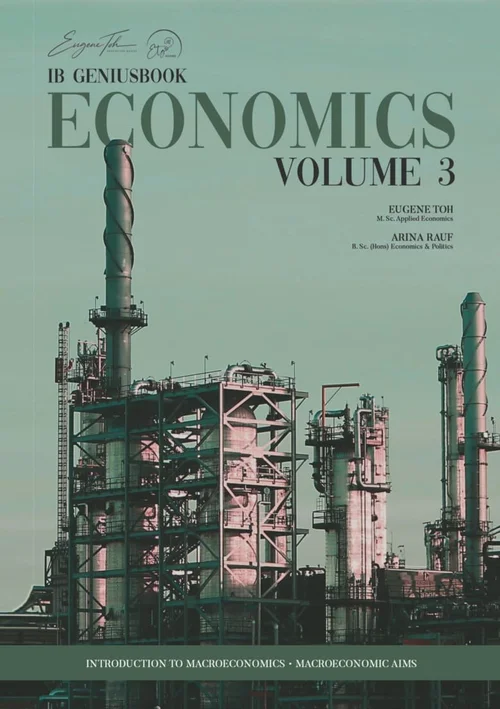
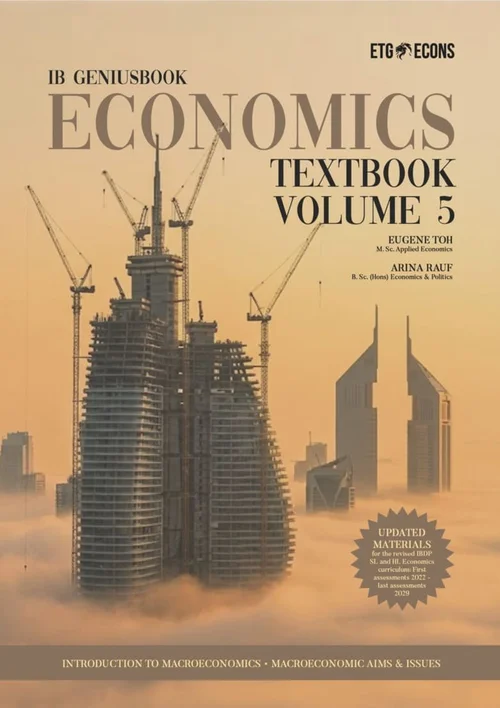
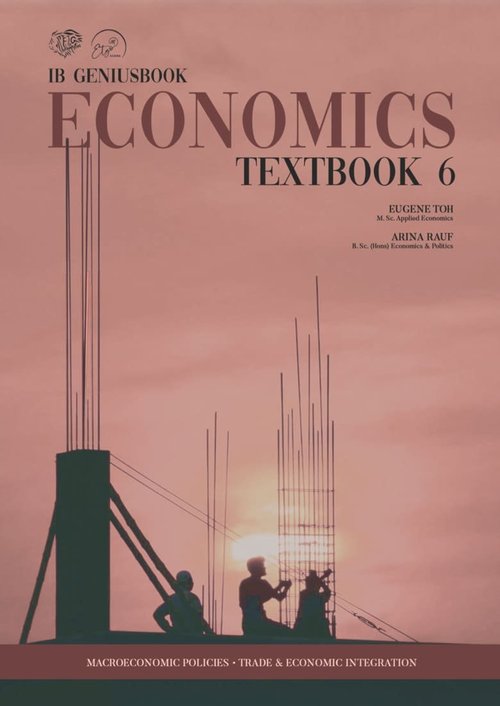
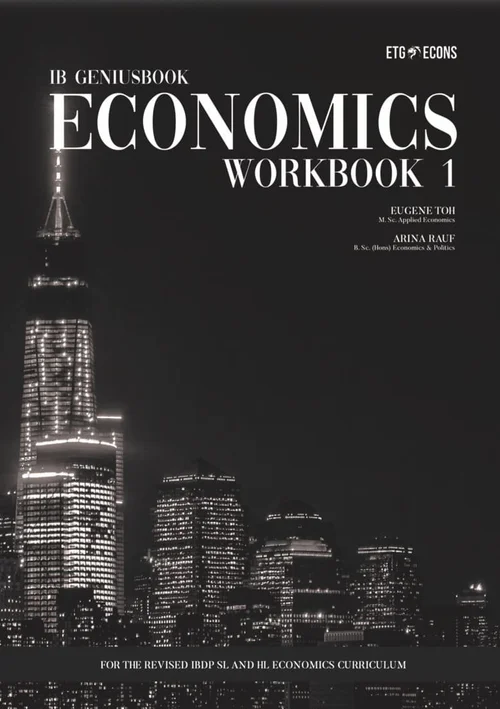
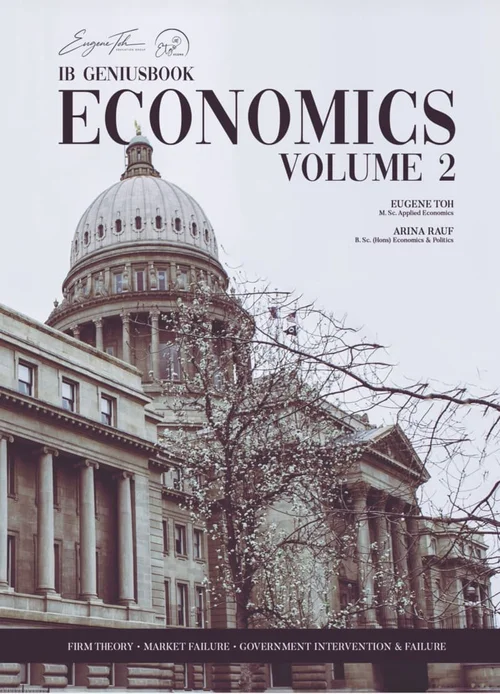
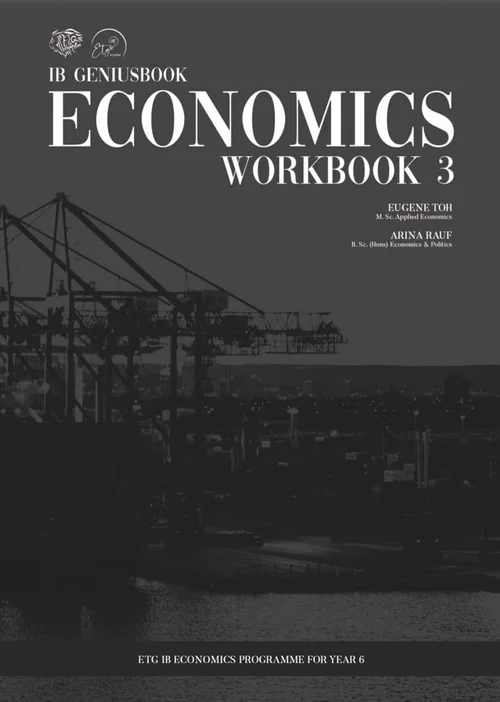
Across two years, your child receives eleven professionally bound resources, each personally written by Mr Eugene Toh and updated every year to the current IB syllabus. A textbook or workbook every term, never a photocopy.
Mr Toh's other titles are published and on sale: the H1 and H2 TYS answer keys, published by SAP, and the 50 Model Essays series are stocked at Popular. The IB Geniusbooks are deliberately not. They are written, designed, typeset, proofread and printed in house, in short runs, for one cohort at a time.
No bookshop carries them, no other centre teaches from them, and there is no retail price, because there is no retail. The only way to hold one is to be an enrolled ETG IB student.
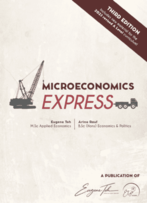
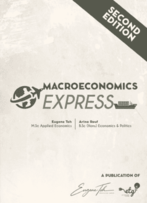
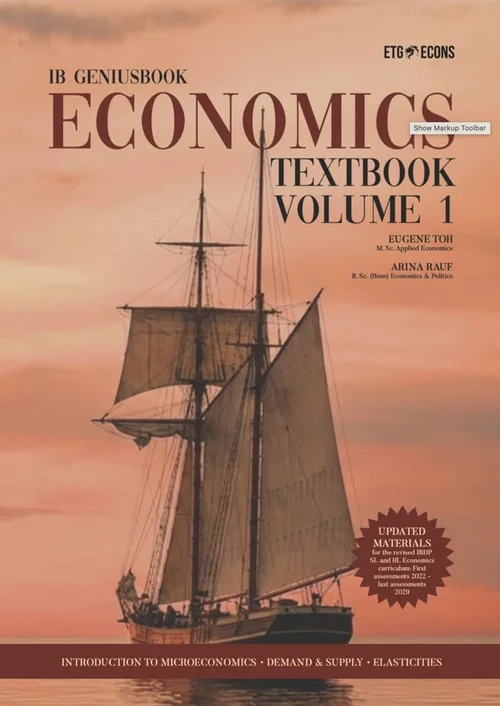
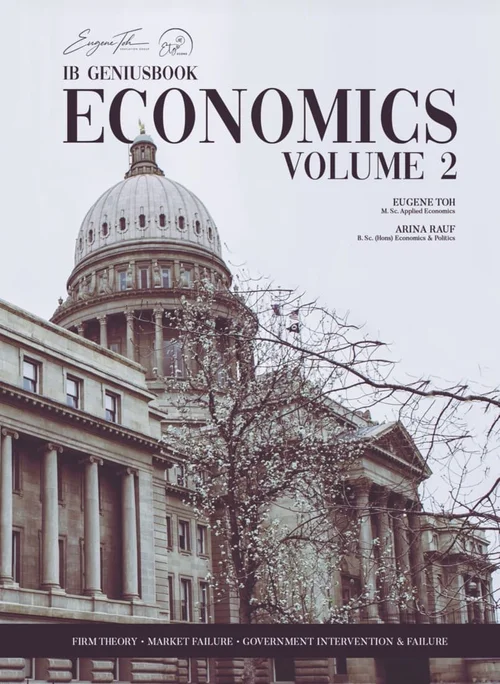
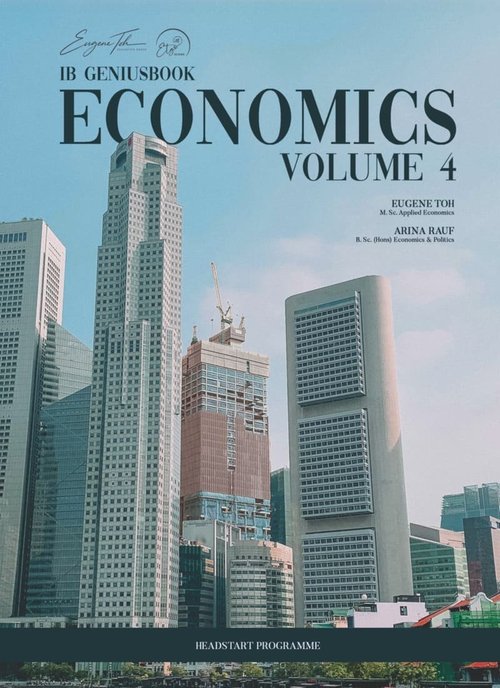
These are real pages from the two most recent volumes, as they went to press. Full bleed chapter openers, set piece infographics drawn from nothing, data spreads sourced to the original statistics, and practice papers typeset to IB conventions. Every figure is redrawn in house. Every number carries a citation.
225 pages. The macroeconomic aims, the Global Financial Crisis, behavioural economics, market failure and government failure, Singapore's tax system, two economies compared, and four full IB practice sets with their own answer booklets.
The final run at the papers. Six exam practice lessons across Paper 1, Paper 2 and Paper 3, then three predictive mock examinations, counted down week by week to the November Economics papers.
Every chapter opens on a photograph and a paragraph that tells your child why the next twenty pages matter


One diagram per chapter is built from scratch, to do work that a paragraph cannot


Volume 8 is pure practice. Question papers typeset to IB conventions, with the answer booklets issued separately


Volume 4 (IB) runs to 225 pages at A4, professionally bound. Both volumes are set in house on our own press files and reset every year against the current IB syllabus, so a diagram that changed in the guide changes in the book. Neither is available for sale.
One of Singapore's most published Economics educators and the author of the H1 and H2 TYS answer keys published by SAP and sold at Popular, and the 50 Model Essays series published with SAP. He personally writes every textbook, workbook and resource in the IB programme, and trains the team that delivers it.
"I design the system. I write the materials. And I train a team of exceptional tutors to deliver it, so every IB student gets the same rigorous, exam focused instruction."
SMU Economics double major, Dean's List for all four years, recipient of the SMU Academic Excellence Award for Economics, and a Lee Kong Chian Scholar, formerly of RI and RGS. Leads the IB Economics programme at ETG.
M.Sc. Business Analytics from Carnegie Mellon and a B.A. Economics from Cambridge. Combines quantitative rigour with theory, ideal for Paper 3 mastery.
NUS Economics, trained directly under Mr Toh's methodology over four years at ETG. Specialises in economic reasoning and essay technique.
Every tutor, the same standard. All IB economics tutors are trained on Mr Toh's methodology, use his materials, and follow ETG's exam focused framework.
Every practice set your child sits is deconflicted before a word of it is written. A burn register records every donor question and every stimulus country used across both years, so no question and no country is ever reused between Year 5 and Year 6. A coverage map grades what has already been drilled, from referenced through defined, calculated, diagrammed and explained to evaluated, so a Term 4 paper does not spend its marks re-drilling what Term 1 already taught.
No chapter goes to print until Mr Toh has gated it. That is the machinery behind a book, and it is why the books cannot be bought.
IB students are already stretched. Our centre is designed to feel calm and refreshing, a place where students arrive tired and leave energised, not burnt out.
Brain fuel on the house, to keep energy up through intensive sessions.
Bring your meals, warm them up, and eat comfortably before class.
Deliberately small classes, so every student gets genuine attention.
IB group classes are held at our flagship centre, Coronation Plaza, 587 Bukit Timah Road. IA support comes through our AI tools, consultation requests with our tutors, or dedicated paid 1-1 sessions. Private one to one is available at Bukit Timah, Kovan, Pasir Ris, or online over Zoom, taught by the same specialist team. See our private 1 to 1 programme →
We would rather you heard it from them. Real ETG IB students, on the programme and the result.
ETG IB students come from SJI, ACS Independent, HCI, SOTA, UWC, Singapore American School and Tanglin. Read 500+ verified reviews →
Whether your school sits the November or the May examinations, there is a route built for your timeline.
For both HL and SL. SL students attend the HL class and are told which lessons they may skip.
Group sign-up discount: register with a friend, $50 off per term. A group of 3, $100 off per term. A group of 4, $150 off per term.
We will build a dedicated class around your school's May timeline, or pair you with a specialist tutor. Explore one to one →
Attend a trial class, subject to availability. Experience the dedicated IB difference before committing.
Attend a Trial ClassAll group fees include the full LMS, all 11 IB resources, and the flexibility to switch between onsite and online. Confidential financial assistance of 25% to 100% is available for the weekly programme, subject to approval. See the full schedule and fees →
ETG runs dedicated IB Economics classes, never mixed with A Level students, taught from an in-house IB curriculum and 11 IB specific textbooks and workbooks written by founder Mr Eugene Toh and printed in house. Behind the teaching sits an IB corpus most centres do not attempt: 60 IB papers from 2019 to 2024 transcribed, tagged part by part against the syllabus and answered in full, 864 question parts mapped to 227 sub concepts, and a written IB writing standard every tutor is held to. The teaching is focused on what the IB rubric rewards across Paper 1, Paper 2, the HL Paper 3, and the Internal Assessment.
Dedicated IB group classes are $120 per lesson, onsite or on Zoom, for both IB Year 5 and Year 6. Group sign-up discount: register with a friend, $50 off per term. A group of 3, $100 off per term. A group of 4, $150 off per term. Private one to one ranges from $150 to $250 per hour depending on the tutor. All group fees include the 11 IB resources and full LMS access. Every lesson is recorded. You can replay any lesson conducted while you are enrolled, whether you attended it or missed it, building to 100+ recordings across the full two-year IB course. Attend a trial class, subject to availability. Confidential financial assistance of 25% to 100% is available for the weekly programme, subject to approval.
No. IB students are never placed in an A Level class. The difference is not only the papers, it is the conventions. The IB accepts two aggregate supply models, the monetarist model with a vertical LRAS and the IB Keynesian curve, while A Level runs on one, so students who meet only one model hesitate when a question expects the other. IB Paper 1 requires a named, dated real world example developed across several sentences, which inverts the A Level rule. Singapore specific material such as ERP, COE and MAS belongs to A Level answers, while the IB rewards global context. ETG teaches IB from its own curriculum, its own IB specific materials and a written IB writing standard, not repackaged A Level content.
In recent cohorts, over 95% of our IB students scored a 7, self-reported by students. The figure is self reported and carries response and selection bias, and past results do not guarantee future ones. We publish it because students told us themselves, and we lead with student videos because they are the stronger proof.
The programme is designed by Mr Eugene Toh, M.Sc. Applied Economics from SMU and B.A. Economics from NUS, author of the H1 and H2 TYS answer keys, and delivered by a handpicked specialist team including Ms Cherilyn, Head of IB Economics, a Lee Kong Chian Scholar from SMU, and Mr Zhu, who holds a B.A. Economics from Cambridge and an M.Sc. from Carnegie Mellon. Every tutor is trained on Mr Toh's methodology and materials.
Yes. Group classes cater to both. SL students attend the HL class and are told which lessons, such as HL only Paper 3 content, are not relevant to their syllabus, so they focus only on what they are examined on while benefiting from the same teaching and resources.
Yes. Every group class is available via Zoom livestream, and students switch between onsite at Coronation Plaza and online anytime. Every lesson is recorded and uploaded to the LMS after class. You can replay any lesson conducted while you are enrolled, whether you attended it or missed it. Private one to one is available online as well as at Bukit Timah, Kovan and Pasir Ris.
Your child is smart enough to score a 7. They need the right system, one that teaches clarity, masters the rubric, and removes the mark killers. That is what ETG provides.
Our admin team will contact you within 24 hours
Last updated July 2026